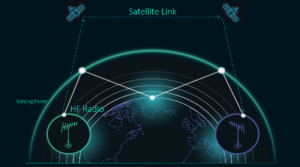
HF radio latency will consistently outperform satellite-based links
If latency is the objective, signals transmitted over HF will arrive first. There is currently no known alternative that can exceed it, including Low Earth Orbit (LEO) satellites.
Both HF and satellite links operate at the speed of light in air. The difference is not in the speed of propagation, but in path efficiency. HF benefits from a shorter, more direct route, resulting in lower latency before accounting for additional system-level advantages.
It Starts with Distance
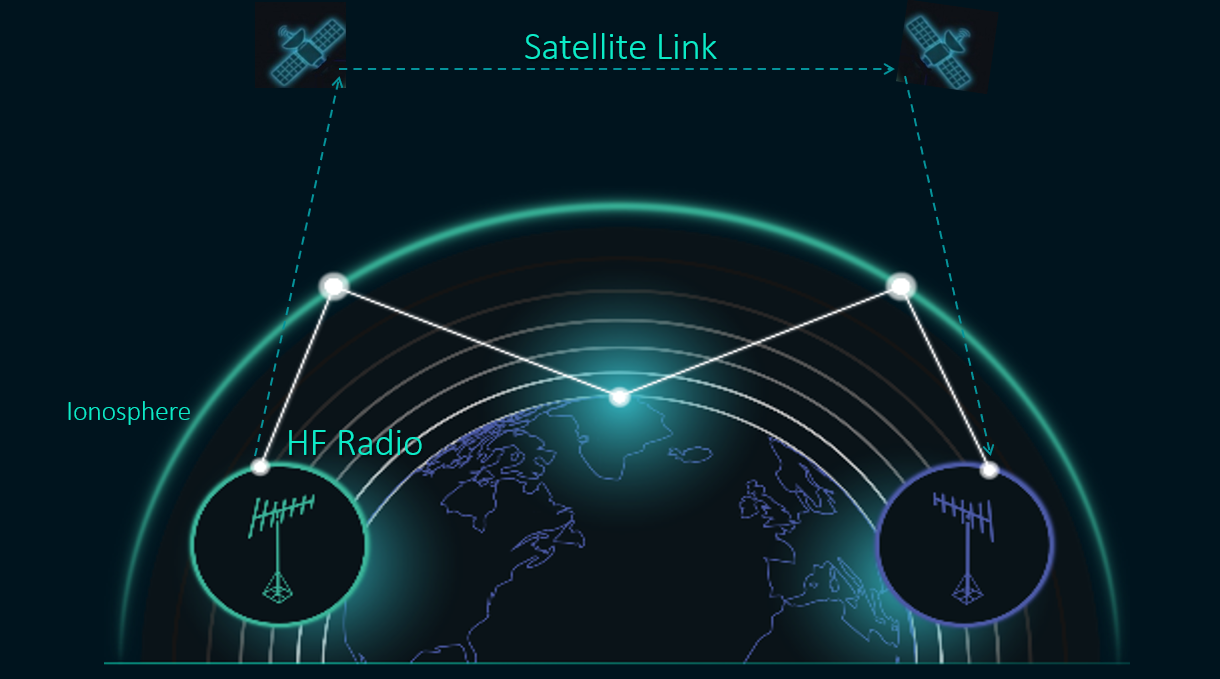
HF path
- Follows a near-geodesic route between fixed points on Earth
- Reflects off the ionosphere (typically up to ~250 km altitude)
- Requires periodic hops (~every 3,000 km)
LEO satellite path
- Operates at higher altitudes (typically ≥480 km)
- Involves routing through moving satellite nodes
- The path is not strictly aligned with the shortest geodesic route
Both systems are fast.
HF is simply shorter and more direct.
Paths illustration:
Why HF Has the Edge
1. Shorter path geometry
HF propagation approximates the shortest path between two terrestrial endpoints.
2. Fewer transmission segments
HF typically involves a single end-to-end transmission.
LEO requires multiple segments:
- Ground → satellite
- Satellite (inter-satellite links)
- Satellite → ground
- Each segment introduces additional latency.
3. Designed for ultra-low latency
RAFT’s HF system – including modems, other hardware, and site placement- is optimized for minimal processing delay and financial market connectivity.
Current LEO systems are not latency-first architectures; they are primarily optimized for broadband connectivity. Even if this evolves, the structural advantages of HF (points 1 and 2) remain.
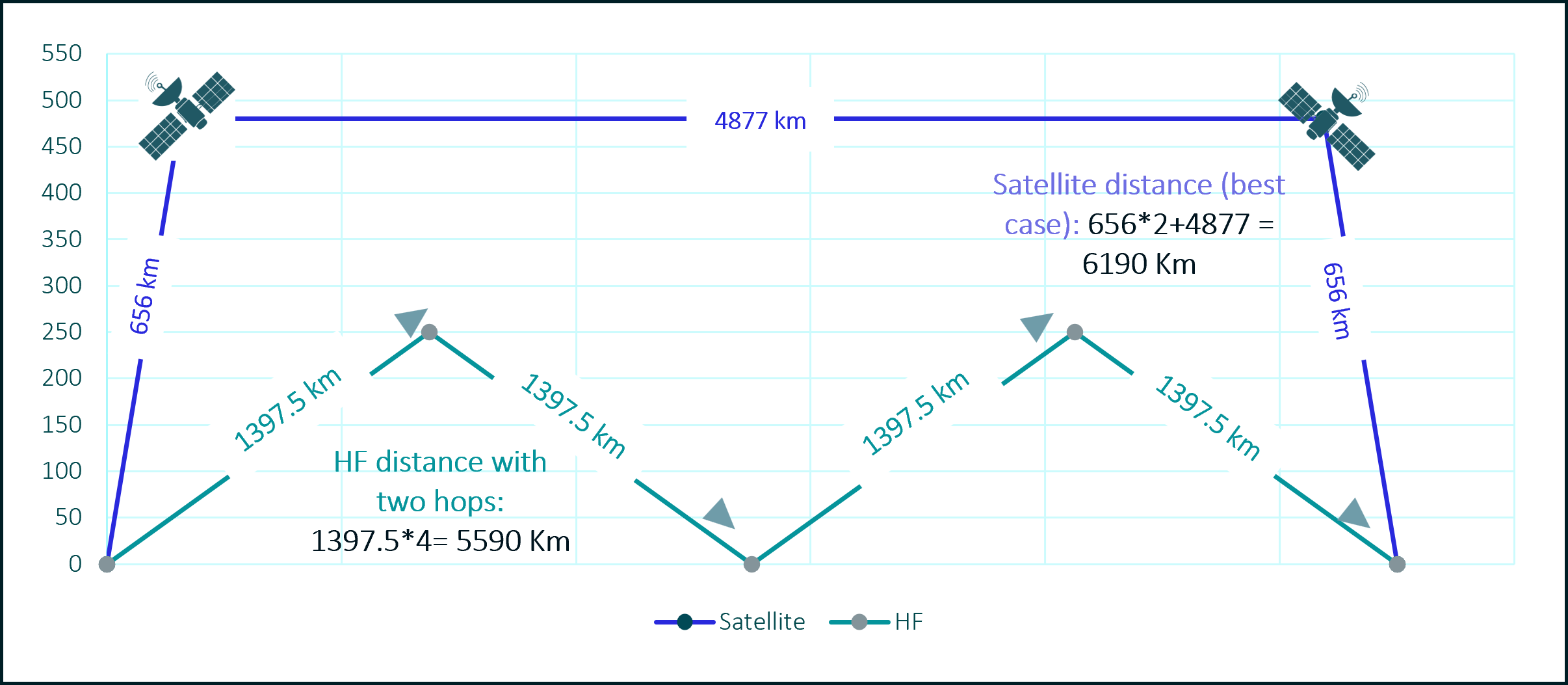
Example: New York → London
Latency comparison – time in air (end-to-end latency includes additional processing time and first and last mile)
HF: ~5,590 km → ~18.6 ms
LEO: ~6,190 km → ~20.6 ms
~2 ms advantage to HF
On longer routes (e.g., trans-Pacific), the HF Radio advantage increases further.
CHI–LDN Case Study:
Where LEO still has advantages
LEO serves different strengths:
- Higher bandwidth capacity
- More consistent availability (independent of ionospheric conditions)
- Faster deployment in new regions
- Coverage where HF infrastructure is not present
The technologies are complementary, not mutually exclusive.
Bottom Line
HF for the fastest signals. LEO as a complementary and backup infrastructure.
If you’d like to explore tailored solutions or have questions, our team is here to help.
— The Raft Team